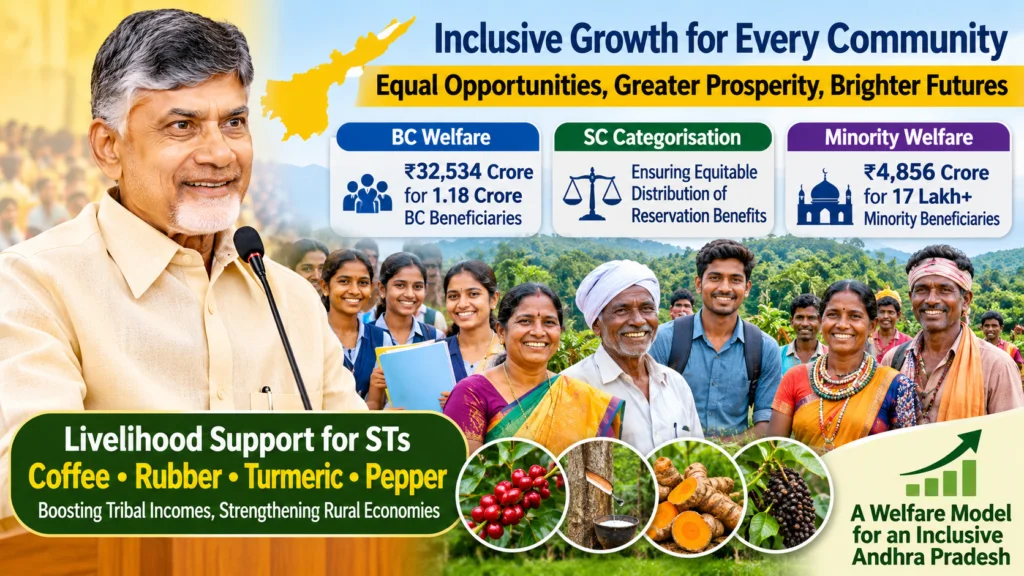
Andhra Pradesh Chief Minister Nara Chandrababu Naidu has placed welfare empowerment for weaker sections at the centre of his government’s development agenda, focusing on backward classes empowerment, SC sub-categorisation, and minority welfare schemes as pillars of an inclusive growth model for the state. According to official figures shared by the state government, Rs. 32,534 crore in financial assistance has been extended to over 1.18 crore Backward Classes (BC) beneficiaries, reflecting one of the largest welfare disbursements aimed at strengthening the economic base of BC communities across Andhra Pradesh.
Alongside this, the government has moved forward with the implementation of SC categorisation, a long-pending demand aimed at ensuring more equitable distribution of reservation benefits among Scheduled Caste sub-groups, so that welfare resources reach the most underserved communities within the SC population rather than being concentrated among a few dominant groups. The Chandrababu Naidu-led NDA government has also prioritised minority welfare, with Rs. 4,856 crore in assistance disbursed to more than 17 lakh minority beneficiaries, signalling a continued commitment to social justice and equal opportunities for religious minority communities in the state.
A distinctive feature of this welfare push is the government’s focus on livelihood generation for Scheduled Tribes (ST) through targeted cultivation and production expansion programmes for coffee, rubber, turmeric, and pepper, crops that are closely tied to tribal economies in the Agency and hill regions of Andhra Pradesh. By expanding cultivation of these cash crops, the state aims to improve income generation for ST families, strengthen market linkages, and reduce dependence on traditional subsistence farming, thereby creating sustainable livelihood opportunities rooted in the natural resources of tribal belts. This approach reflects a broader strategy under Chandrababu Naidu’s leadership that combines direct financial assistance with skill-based and produce-based economic empowerment, rather than relying solely on cash transfers.
The government has framed these initiatives as part of a larger vision of inclusive growth for every community, arguing that greater prosperity for historically marginalised groups — including BCs, SCs, STs, and minorities — is essential for the state’s overall development trajectory. Officials associated with the programme have highlighted that the scale of assistance, spanning crores of rupees and reaching millions of beneficiaries, represents an effort to ensure that economic growth in Andhra Pradesh is not limited to urban or already-advantaged sections of society but extends to farmers, artisans, women, youth, and rural households across the state. The emphasis on social justice, caste-based welfare distribution, and community-specific livelihood programmes positions this initiative as a significant policy direction for Andhra Pradesh, with implications for how welfare governance and targeted development schemes are designed in the state going forward.
As these schemes continue to roll out, the Andhra Pradesh government’s welfare model is likely to remain a closely watched example of how caste-based sub-categorisation, minority assistance programmes, and crop-based tribal livelihood initiatives can be combined under a single inclusive development framework, aimed at delivering brighter futures for weaker and marginalised sections of society across the state.